Wednesday, May 31, 2006
Infidel Question Of The Day
What will we have to do to kick Islamofascism the hell off the face of the Earth?


Marcello Pera on Europe and War
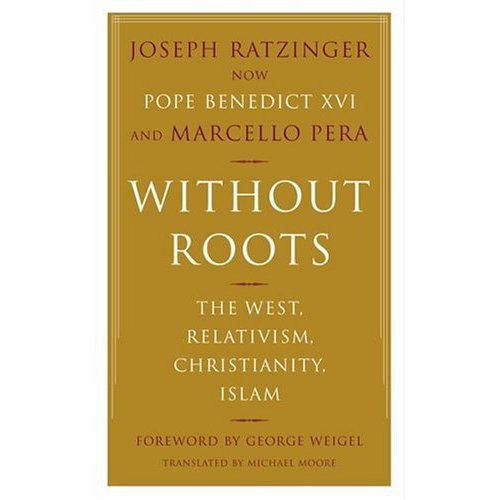
I am reposting this rather long quote from the book Without Roots : The West, Relativism, Christianity, Islam, a collection of letters on the title subject between Italian Philosopher Marcello Pera (quoted below) and Cardinal Joseph Ratzinger, now Pope Benedict XVI. Fabulous book, with this quote being part of a section I found appropriate to add to my analysis of Mahmoud Ahmadinejad's infamous Der Spiegel interview:
"So why should Europe reject the very fact of war? Why should the same Church that once launched crusades refuse to see a war that has been declared against "Jews and crusaders," as Islamic terrorists say every day? Do the Church and Europe realize that their very existence is at stake, their civilization has been targeted, their culture is under attack? Do they understand that what they are being called on to defend is their own identity? Through culture, education, diplomatic negotiations, political relations, economic exchange, dialogue, preaching, but also if necessary, through force?
I fear that Europe has not realized this. And thus I fear that European pacifism, however noble and generous it may be, is not so much a realistic, meditated, conscious choice as a heedless, passive consequence of its angelic relativism. This is why I speak of the spirit of Munich, which has an additional irritant today. Namely, that relativism, after teaching that all cultures and all civilizations are equal, makes the contradictory insinuation that our culture and our civilization are worse than others. Hence, there has been a spread-especially throughout Europe-of a sense of guilt, of self-flagellation, of a need for forgiveness from which not even the Church is exempt, together with a smugness of the dangers avoided. The September 11 atrocity? Blame it on our own genocidal acts, says Chomsky. Suicide bombs? Our fault: We have reduced the Palestinians to desperation, says Saramago. And so on, accompanied by a crescendo of breast-beating. How can we restore realism to a Europe that thinks along such lines?"
He has his finger on the problems at hand as accurately as does Ahmadinejad. The trouble is that Ahmadinejad has the missiles, the nuclear program, a whole nation to rule, as well as the fighters and the will to fight without any of the self- guilt that needlessly plagues the West. I can only hope that the correct experts are consulted for media responses to Mahmoud's latest round of Taqiyya. Yet hope all that I want, I have little faith that this will happen. Of course the experts will weigh in, but as has happened since 9/11 their analysis will fall mostly on deaf ears, if it reaches them at all.
************************
The rest is at my site, which I have finally revived myself enough to write at again. HAHAH!
What Would Charles Martel Do?
Tuesday, May 30, 2006
A Tale of Two Wars
Courtesy of Security Watchtower (I apologize for the fly-speck font in the following graphic, but I thought this was worth passing along):

Paris In Springtime

The "youths" are at it again, and they're after the Mayor:
PARIS (Reuters) - Youths clashed with police in a Paris suburb overnight and attacked the home of the local mayor in disturbances one police union said were the worst since a wave of urban riots shook France in November.
French media said some 150 youths armed with baseball bats fought around 250 police for four hours in Montfermeil north of Paris after the arrest of a youth suspected of attacking a bus driver, an incident witnessed by the local mayor Xavier Lemoine.
Youths smashed windows, hurled two petrol bombs at the town hall and stoned the mayor's home, the media reports said.
Seven police officers were slightly hurt in the violence, in which six youths were detained, police said. Three remained in custody.
"Around 100 hooded youths stoned my home shouting 'the mayor is a son of a bitch'," Le Monde newspaper quoted Lemoine as saying. "The clashes took place 50 meters (yards) from my home."
Lemoine, a married reserve naval officer with seven children, said he had been targeted after coming to help a bus driver being assaulted by youths who then recognized him.
The arrest of a suspect in the attack late on Monday triggered the violence, he said.
The mayor, whose home and family have previously been set upon, courted controversy last month when he banned unsupervised under-aged youths from gathering in groups in the town center. The order was later overturned by an administrative court.
Michel Thooris, secretary general of the Action Police CFTC union, said the latest violence was the worst since November.
"Last night we saw the strongest after-shock of the earthquake of November 2005 that hit the suburbs. The situation in the suburbs remains explosive," he said in a statement, calling on Interior Minister Nicolas Sarkozy to put community officers back on the beat to reduce tensions.
Yes, in Paris, they think this is an aftershock. I doubt it.
What do we talk about after Holocaust Denial? Nuclear Weapons, what else? More from Der Spiegel
SPIEGEL: Mr. President, we're talking about the Holocaust because we want to talk about the possible nuclear armament of Iran -- which is why the West sees you as a threat.Ahmadinejad: Some groups in the West enjoy calling things or people a threat. Of course you're free to make your own judgment.
SPIEGEL: The key question is: Do you want nuclear weapons for your country?

DODGE ALERT - this is guy is not dumb read the answer carefully ..he is saying WE ARE NOT THE PROBLEM
Ahmadinejad: Allow me to encourage a discussion on the following question: How long do you think the world can be governed by the rhetoric of a handful of Western powers? Whenever they hold something against someone, they start spreading propaganda and lies, defamation and blackmail. How much longer can that go on?
I don't exactly understand the connection -Stupid? I don't think so
Ahmadinejad speaks to Der Spiegel
Beyond words
SPIEGEL: First you make your remarks about the Holocaust. Then comes the news that you may travel to Germany -- this causes an uproar. So you were surprised after all?Ahmadinejad: No, not at all, because the network of Zionism is very active around the world, in Europe too. So I wasn't surprised. We were addressing the German people. We have nothing to do with Zionists.
SPIEGEL: Denying the Holocaust is punishable in Germany. Are you indifferent when confronted with so much outrage?
Ahmadinejad: I know that DER SPIEGEL is a respected magazine. But I don't know whether it is possible for you to publish the truth about the Holocaust. Are you permitted to write everything about it?
The Hojatieh do not think as we do, do not conclude in the same way and from the same objective reference set. They exist in the world of wishing and faith - belief in the suspension of proof.
Danish People's Church: "Muslims And Christians Do Not Believe In The Same God"
In yet another sign that Europe is waking up to its problem with Islamofascism, the official church of the state of Denmark has announced that Muslim Imams are not welcome in their churches, and that Muslims and Christians do not direct their worship at the same entity (report from Dymphna at Gates of Vienna):
(The) state church, Folkekirken, which is Denmark’s official evangelical Lutheran denomination. No one has to join, and you can opt out of paying any tax for its upkeep, though if you’re a lazy or indifferent type and don’t phone the local municipality, you will be billed for church maintenance. What’s interesting is that while eighty four per cent of Danes pay the tax and are official members, only about five per cent of these citizens are actually church-goers.
" ... Imams are not welcome in Danish state churches," says a new network of Islam-critical priests and theological experts.
The purpose is to state that Christians and Muslims do not believe in the same God, and that the church and the mosque are not religious equals says the new network of 60 priests and theological experts.
Well-known priests and opinion-makers such as Niels Højlund, Sørine Godtfredsen, Edith Thingstrup, Morten Kvist and Katrine Winkel Holm are among the prominent members.
According to the Newfounded Network admitting imams into Danish churches is problematic.
The Danish People’s Church cannot agree with the imams without betraying the Lord Christ — who according to Islam is nothing but an inferior “prophet”, subordinated to Mohammad.
When priests and imams are praying together, they are in essence ridiculing the Gospel, the network states. At the same time it distances itself from recent events such as religious councils with imams.
Bishops and imams are not religious colleagues separated only by different merchandise. It is of paramount importance that priests in the Danish Church make that fact very clear — as well as studying and criticizing Islam, says the network — which at the same time underscores that the intention is to criticize Islam, not the individual Muslim.
Dymphna, at Gates of Vienna, comments:
Is this what Christians would call a “Christian attitude”? In a smaller sense, no. But in the larger sense of putting a stop to the inroads some of the more notorious imams in Denmark have made into a hither-to civilized cultural life, and the economic damage they have caused Denmark by spreading taqiyya in the Middle East, causing boycotts of Danish goods and the destruction of Danish embassies, they are possibly serving a greater good.
The shameful spineless of American mainstream churches in the face of militant Islam, their divestment from tiny, besieged Israel, their unwitting and ignorant support of the spread of Islamicist propaganda in this country, makes Denmark’s line drawn in the sand a refreshing change.
I think this is a good starting point for me to discuss something I have been thinking about of late. The question Dymphna poses is a wise one. "Is this a Christian attitude," or, in other words, does it betray Christian values to reject ecumenicism, or, an approach of agreement, cooperation, and understanding, with an Abrahamic religion?
In short, I think we need not even address that question. Because, before we even get to it, our answer should be clear to us.
The first principle of the Judeo-Christian Christian tradition, and really, the first thing the Bible, itself, discusses, in Genesis, about the relationship of God and man, is that man was created in the Image of God. This does not mean that we look like God. What it means is that we were created with the attributes of God.
And, what are the attributes of God?
We need only look at that passage in the beginning of Genesis to understand.
"In the beginning,
1) God created the heavens and the Earth,"
2) He created the beasts of the field,
3) He separated the waters,
4) He created man of dust, and
5) breathed His own life into him, and then,
6) seeing that it was not good for man to be lonely, and moved by compassion, He created, for him, a female companion named Eve.
We can take from this that man God and, thereby man, are, among other things,
1) Creative and magnificent of vision
2) in love with reproduction and the process of life
3) analytical in our creativity, and completely willing to remake, or reshape, what we have already made, even if we have seen that "it is Good."
4) in love with matter itself
5) generous, willing to give of ourselves in our own creative process
6) loving, reasonable, and willing to change our plans, when moved by compassion.
There are many other things that can be inferred from the opening passage of Genesis, but this is enough for my argument.
The point is, both Judaism and Christianity teach that God is loving, reasonable, and creative. Both Judaism and Christianity teach that man, having been made in the Image of his Creator, also inherently possesses these attributes to some extent. Therefore, man is meant to be creative, he is meant to love matter, he is meant to be reasonable and analytical, he is meant to reshape his work, and even, the work of God's hands, using the gifts of reason and analysis, and more than anything, man is meant to be Free, as God, most indubitably, is Himself.
And, what's more, God wants man to have Freedom of choice. He wants man to come to Him of his own accord. When man sinned, God could have unmade the sin, and started over, but instead, God worked with the new reality man had created, and even promised to make something more glorious of it.
In other words, when God was confronted with man's sin, and He banished the sinners from the Garden of Eden, He did not make it His next step to take away man's Free Will, but instead, chose for man to retain Free Will, and He chose to remain a partner in man's creative endeavors.
Reading the rest of the Hebrew Bible, and the Gospels, and the Letters, it becomes apparent that God made this decision precisely because He wants man to be Free, otherwise, man would not be free to choose Him.
In other words - and I can't stress enough how important this is -
The first principle of the Bible is that man needs to be Free, and this comes before anything else.
This is not at all a principle of Islam. In Islam, a good Muslim is to learn the Koran by heart, and to follow its rules by rote. He is not to be analytical, because his analysis can never add anything to that which Allah has already provided. The Koran, itself, is the final word of Allah to man. It is not to be amended or added to. It is to be followed only.
Man's creativity is to be impeded. Music must not be made of anything more than chanting and drums. Art must not be representational. It is forbidden for a Muslim to depict the human form in a sculpture, for instance.
Man is to love the paradise Mohammed calls him towards. He is not to love the Earthly realm of matter. In fact, much of the material world is haram, to the extent that man is forbidden to even view the form of any female not his own wife.
In Islam, man is not forbidden to be generous to other men, so long as his fellow man is a Muslim. But, there is no reason to be generous to a non-Muslim. In fact, one is not to take a non-Muslim as a friend.
In Islam, compassion is not the central theme. Allah can not be said to be the equivalent of Love, as the Bible tells us Yahweh is. Allah is instead, probably, more easily called a god of justice, as defined by Allah. Or, is that justice defined by Mohammed. We can't be sure, because when it comes right down to it, the only person from whom we have learned of Allah, is the prophet himself. And, we shall never hear another new word about Allah from anyone else.
So, we see, the god of Islam is not anything like the God of the Bible. We delude ourselves if we think the two can be compared.
What's more, we put ourselves in danger, and, we put our very ability to practice our religion in danger, if we accept the idea that God and Allah are the same. Because Allah does not accept divergence of opinion. It's Allah's way, or the highway. No other opinions, or ideas, or beliefs, are allowed.
Free Speech, Freedom of Conscience, Democracy, these are all but the baubles and bangles of a decadent Western Civilization, as far as the most learned men of Islam are concerned. They all lead to disobedience, and sloth, and weakness, we are told. And most importantly, what we need to know is they all lead away from Allah.
Therefore, if we are to accept that Allah is the same as the God of the Judeo-Christian Bible, we are accepting that Allah is preeminent, and our God must be subservient. We are accepting, therefore, that we are no longer to be free, rational, and analytical beings.
Therefore, we are accepting that we no longer can make our own choices, for Democracy, for Freedom of Conscience, or for our God Himself.
If we accept such, we are condemning ourselves to the destruction of Western Civilization, and we are taking away the very duty of man himself, that is to express himself as a being made in the Image of God.
The Christian Church, in general, must come to understand these things. The most important endeavor the Christian Church can undertake at this point in time is to understand that the defense of Western Civilization is of utmost importance to the existence of Christianity. Without the protection Western Civilization provides to Freedom of Conscience, Freedom of Speech, and Democracy, Christianity itself would go into a dark age. Christians would be forced to worship underground, away from the light of day. Fewer people would hear the gospel preached, and therefore, fewer people would be free to make a choice to follow the God of the Bible.
The Christian Church must understand that Western Civilization and the Bible go hand in hand. The Christian Church must become warriors for Western Civilization. I am not saying that this means the Church itself must call for violence. No, the Church, at this juncture has the luxury still of keeping its advocacy in the realm of peace. We can still fight our battles in the realm of ideology.
However, if the Christian Church, and the West, allow too many of our cherished Freedoms to slip away, it will become incumbent upono the Church, once again, to go into the business of War. And, that will be a shame upon us, not because it would be wrong to call for war in such a case, but, because we could have won our war without violence, if we had only acted sooner.
Let this be a warning to all Pastors, Priests, Rabbis, and Teachers of the Bible of the God of Abraham.
(The) state church, Folkekirken, which is Denmark’s official evangelical Lutheran denomination. No one has to join, and you can opt out of paying any tax for its upkeep, though if you’re a lazy or indifferent type and don’t phone the local municipality, you will be billed for church maintenance. What’s interesting is that while eighty four per cent of Danes pay the tax and are official members, only about five per cent of these citizens are actually church-goers.
" ... Imams are not welcome in Danish state churches," says a new network of Islam-critical priests and theological experts.
The purpose is to state that Christians and Muslims do not believe in the same God, and that the church and the mosque are not religious equals says the new network of 60 priests and theological experts.
Well-known priests and opinion-makers such as Niels Højlund, Sørine Godtfredsen, Edith Thingstrup, Morten Kvist and Katrine Winkel Holm are among the prominent members.
According to the Newfounded Network admitting imams into Danish churches is problematic.
The Danish People’s Church cannot agree with the imams without betraying the Lord Christ — who according to Islam is nothing but an inferior “prophet”, subordinated to Mohammad.
When priests and imams are praying together, they are in essence ridiculing the Gospel, the network states. At the same time it distances itself from recent events such as religious councils with imams.
Bishops and imams are not religious colleagues separated only by different merchandise. It is of paramount importance that priests in the Danish Church make that fact very clear — as well as studying and criticizing Islam, says the network — which at the same time underscores that the intention is to criticize Islam, not the individual Muslim.
Dymphna, at Gates of Vienna, comments:
Is this what Christians would call a “Christian attitude”? In a smaller sense, no. But in the larger sense of putting a stop to the inroads some of the more notorious imams in Denmark have made into a hither-to civilized cultural life, and the economic damage they have caused Denmark by spreading taqiyya in the Middle East, causing boycotts of Danish goods and the destruction of Danish embassies, they are possibly serving a greater good.
The shameful spineless of American mainstream churches in the face of militant Islam, their divestment from tiny, besieged Israel, their unwitting and ignorant support of the spread of Islamicist propaganda in this country, makes Denmark’s line drawn in the sand a refreshing change.
I think this is a good starting point for me to discuss something I have been thinking about of late. The question Dymphna poses is a wise one. "Is this a Christian attitude," or, in other words, does it betray Christian values to reject ecumenicism, or, an approach of agreement, cooperation, and understanding, with an Abrahamic religion?
In short, I think we need not even address that question. Because, before we even get to it, our answer should be clear to us.
The first principle of the Judeo-Christian Christian tradition, and really, the first thing the Bible, itself, discusses, in Genesis, about the relationship of God and man, is that man was created in the Image of God. This does not mean that we look like God. What it means is that we were created with the attributes of God.
And, what are the attributes of God?
We need only look at that passage in the beginning of Genesis to understand.
"In the beginning,
1) God created the heavens and the Earth,"
2) He created the beasts of the field,
3) He separated the waters,
4) He created man of dust, and
5) breathed His own life into him, and then,
6) seeing that it was not good for man to be lonely, and moved by compassion, He created, for him, a female companion named Eve.
We can take from this that man God and, thereby man, are, among other things,
1) Creative and magnificent of vision
2) in love with reproduction and the process of life
3) analytical in our creativity, and completely willing to remake, or reshape, what we have already made, even if we have seen that "it is Good."
4) in love with matter itself
5) generous, willing to give of ourselves in our own creative process
6) loving, reasonable, and willing to change our plans, when moved by compassion.
There are many other things that can be inferred from the opening passage of Genesis, but this is enough for my argument.
The point is, both Judaism and Christianity teach that God is loving, reasonable, and creative. Both Judaism and Christianity teach that man, having been made in the Image of his Creator, also inherently possesses these attributes to some extent. Therefore, man is meant to be creative, he is meant to love matter, he is meant to be reasonable and analytical, he is meant to reshape his work, and even, the work of God's hands, using the gifts of reason and analysis, and more than anything, man is meant to be Free, as God, most indubitably, is Himself.
And, what's more, God wants man to have Freedom of choice. He wants man to come to Him of his own accord. When man sinned, God could have unmade the sin, and started over, but instead, God worked with the new reality man had created, and even promised to make something more glorious of it.
In other words, when God was confronted with man's sin, and He banished the sinners from the Garden of Eden, He did not make it His next step to take away man's Free Will, but instead, chose for man to retain Free Will, and He chose to remain a partner in man's creative endeavors.
Reading the rest of the Hebrew Bible, and the Gospels, and the Letters, it becomes apparent that God made this decision precisely because He wants man to be Free, otherwise, man would not be free to choose Him.
In other words - and I can't stress enough how important this is -
The first principle of the Bible is that man needs to be Free, and this comes before anything else.
This is not at all a principle of Islam. In Islam, a good Muslim is to learn the Koran by heart, and to follow its rules by rote. He is not to be analytical, because his analysis can never add anything to that which Allah has already provided. The Koran, itself, is the final word of Allah to man. It is not to be amended or added to. It is to be followed only.
Man's creativity is to be impeded. Music must not be made of anything more than chanting and drums. Art must not be representational. It is forbidden for a Muslim to depict the human form in a sculpture, for instance.
Man is to love the paradise Mohammed calls him towards. He is not to love the Earthly realm of matter. In fact, much of the material world is haram, to the extent that man is forbidden to even view the form of any female not his own wife.
In Islam, man is not forbidden to be generous to other men, so long as his fellow man is a Muslim. But, there is no reason to be generous to a non-Muslim. In fact, one is not to take a non-Muslim as a friend.
In Islam, compassion is not the central theme. Allah can not be said to be the equivalent of Love, as the Bible tells us Yahweh is. Allah is instead, probably, more easily called a god of justice, as defined by Allah. Or, is that justice defined by Mohammed. We can't be sure, because when it comes right down to it, the only person from whom we have learned of Allah, is the prophet himself. And, we shall never hear another new word about Allah from anyone else.
So, we see, the god of Islam is not anything like the God of the Bible. We delude ourselves if we think the two can be compared.
What's more, we put ourselves in danger, and, we put our very ability to practice our religion in danger, if we accept the idea that God and Allah are the same. Because Allah does not accept divergence of opinion. It's Allah's way, or the highway. No other opinions, or ideas, or beliefs, are allowed.
Free Speech, Freedom of Conscience, Democracy, these are all but the baubles and bangles of a decadent Western Civilization, as far as the most learned men of Islam are concerned. They all lead to disobedience, and sloth, and weakness, we are told. And most importantly, what we need to know is they all lead away from Allah.
Therefore, if we are to accept that Allah is the same as the God of the Judeo-Christian Bible, we are accepting that Allah is preeminent, and our God must be subservient. We are accepting, therefore, that we are no longer to be free, rational, and analytical beings.
Therefore, we are accepting that we no longer can make our own choices, for Democracy, for Freedom of Conscience, or for our God Himself.
If we accept such, we are condemning ourselves to the destruction of Western Civilization, and we are taking away the very duty of man himself, that is to express himself as a being made in the Image of God.
The Christian Church, in general, must come to understand these things. The most important endeavor the Christian Church can undertake at this point in time is to understand that the defense of Western Civilization is of utmost importance to the existence of Christianity. Without the protection Western Civilization provides to Freedom of Conscience, Freedom of Speech, and Democracy, Christianity itself would go into a dark age. Christians would be forced to worship underground, away from the light of day. Fewer people would hear the gospel preached, and therefore, fewer people would be free to make a choice to follow the God of the Bible.
The Christian Church must understand that Western Civilization and the Bible go hand in hand. The Christian Church must become warriors for Western Civilization. I am not saying that this means the Church itself must call for violence. No, the Church, at this juncture has the luxury still of keeping its advocacy in the realm of peace. We can still fight our battles in the realm of ideology.
However, if the Christian Church, and the West, allow too many of our cherished Freedoms to slip away, it will become incumbent upono the Church, once again, to go into the business of War. And, that will be a shame upon us, not because it would be wrong to call for war in such a case, but, because we could have won our war without violence, if we had only acted sooner.
Let this be a warning to all Pastors, Priests, Rabbis, and Teachers of the Bible of the God of Abraham.
15.000.000 muslims in the EU in 2005
Newest numbers from Zentralinstituts Islam-Archiv Deutschland (ZIAD) show that in the EU’s 25 membercountries are 14.860.000 muslims.
Biggest procentual number is Cypern, with 200.000 of a population of 770.000.
This is 25,97%. After Cypern follows France with 5,5 million muslims, from a population of 59,34 million which is 9,27%. Third is Holland, with one million muslims numbering 6,2% of 16,14 million. Number 4 is Austria with 350.000 of 8,05 million (4,35%). Fewest muslims you find in Poland, with a populace of 38,6 million, and 7.000 muslims (0,02%). Muslims are 3,3% af EU’s population.
From Hodja
-->
Biggest procentual number is Cypern, with 200.000 of a population of 770.000.
This is 25,97%. After Cypern follows France with 5,5 million muslims, from a population of 59,34 million which is 9,27%. Third is Holland, with one million muslims numbering 6,2% of 16,14 million. Number 4 is Austria with 350.000 of 8,05 million (4,35%). Fewest muslims you find in Poland, with a populace of 38,6 million, and 7.000 muslims (0,02%). Muslims are 3,3% af EU’s population.
From Hodja
-->
Monday, May 29, 2006
Memorial Day? Try This One: May 29, 1453
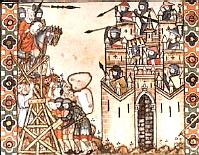
Today, our Memorial Day for 2006, marks the 553rd anniversary of the fall of Constantinople. Paul Belien gives a moving account of the story at Brussels Journal. His recalling of the appeasement that led up to the seizure of the city is especially notable in our time: appeasement is a fool’s vain wish to avoid the predator:
* * * * * * * * * * * * * * *
That is Mr. Belien’s version. Oriana Fallaci, in The Force of Reason, has another more detailed version of Constantinople’s conversion into Istanbul. It is written in her inimitable style, which deserves not to be paraphrased, but quoted in full (pp 42-44):
No, we don’t teach history that way anymore. But Oriana Fallaci is dying, and death gives her freedom to tell the truth, the whole bloody truth, and nothing but the horrendous truth.
This has been a report on the Religion of Peace. They will tell you we made it up.
For a poetic version, see the Baron’s post from January on Yeats’ “Sailing to Byzantium”.

Hat tip: commenter Fluffy.
In 1374, when the Ottomans were only a nascent power, Prince Manuel, governor of Salonica and a son of the Byzantine Emperor, had tried to rally the inhabitants of his city against the Turks. But the Salonicans did not want to bear the high costs of defending their city and promptly threw him out. Out of fear of the Turks his father, Emperor John V, refused Manuel shelter within the walls of Constantinople and so did all the other Byzantine cities. Consequently the prince was forced to seek refuge with... the Ottomans, whom he served until 1394, when he became Emperor himself.
When the Sultan demanded a Byzantine princess from the Emperor, the latter gave away his daughter Theodora to spend the rest of her life in the Sultan’s harem. He also gave the Turks a church in Constantinople to convert into a mosque. All the appeasement was in vain, however, because in 1453 the Turks demanded that the Byzantines surrender Constantinople. This time the Byzantines refused. In their final hour they saved their honour. “They fought for the city as they had never fought for the empire,” writes Jason Goodwin in his history of the Ottoman Empire. After a siege of two months the city fell. Emperor Constantine XI, Manuel’s son, died with his sword in his hand.
That is Mr. Belien’s version. Oriana Fallaci, in The Force of Reason, has another more detailed version of Constantinople’s conversion into Istanbul. It is written in her inimitable style, which deserves not to be paraphrased, but quoted in full (pp 42-44):
…Crashing aside the Christians at Varna in 1444 they secured possession of Walachia, Moldavia, Transylvania, the territory now called Bulgaria and Romania, then in 1453 they put again under siege Constantinople which on May 29 fell into the hands of Mehmet II and by the way: do you know who was Mehmet II? A guy who, by virtue of the Islamic Fratricide Law which authorized a sultan to murder members of his immediate family, had ascended the throne by strangling his three year-old brother. Do you know the chronicle that about the fall of Constantinople the scribe Phrantzes has left us to refresh the memory of the oblivious or rather of the hypocrites?
Perhaps not. Especially in Europe, a Europe that weeps only for the Muslims, never for the Christians or the Jews or the Buddhists or the Hindus, it would not be Politically Correct to know the details of the fall of Constantinople. Its inhabitants who at daybreak, while Mehmet II is shelling Theodosius’ walls, take refuge in the cathedral of St. Sophia and here start to sing psalms. To invoke divine mercy. The patriarch who by candlelight celebrates his last Mass and in order to lessen the panic thunders: “Fear not, my brothers and sisters! Tomorrow you’ll be in the Kingdom of Heaven and your names will survive till the end of time!”. The children who cry in terror, their mothers who give them heart repeating: “Hush, baby, hush! We die for our faith in Jesus Christ! We die for our Emperor Constantine XI, for our homeland!”. The Ottoman troops who beating their drums step over the breaches in the fallen walls, overwhelm the Genovese and Venetian and Spanish defenders, hack them on to death with scimitars, then burst into the cathedral and behead even newborn babies. They amuse themselves by snuffing out the candles with their little severed heads... It lasted from the dawn to the afternoon that massacre. It abated only when the Grand Vizier mounted the pulpit of St. Sophia and said to the slaughterers: “Rest. Now this temple belongs to Allah” Meanwhile the city burns, the soldiery crucify and hang and impale, the Janissaries rape and butcher the nuns (four thousand in a few hours) or put the survivors in chains to sell them at the market of Ankara. And the servants prepare the Victory Feast. The feast during which (in defiance of the Prophet) Mehmet II got drunk on the wines of Cyprus and, having a soft spot for young boys, sent for the firstborn of the Greek Orthodox Grand Duke Notaras. A fourteen year-old adolescent known for his beauty. In front of everyone he raped him, and after the rape he sent for his family. His parents, his grandparents, his uncles, his aunts and cousins. In front of him he beheaded them. One by one. He also had all the altars destroyed, all the bells melted down, all the churches turned into mosques or bazaars. Oh, yes. That’s how Constantinople became Istanbul. But Doudou of the UN and the teachers in our schools don’t want to hear about it.
No, we don’t teach history that way anymore. But Oriana Fallaci is dying, and death gives her freedom to tell the truth, the whole bloody truth, and nothing but the horrendous truth.
This has been a report on the Religion of Peace. They will tell you we made it up.
For a poetic version, see the Baron’s post from January on Yeats’ “Sailing to Byzantium”.
Hat tip: commenter Fluffy.
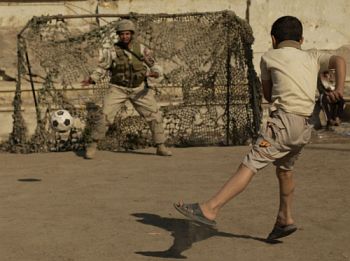
Iraq: The Children

Today I want to talk about a topic that is the most important with regards to the future of Iraq. The children. For it is they who are the vessels of hope for Iraq and it's future.
To be a child in Iraq during this time must be a mixed bag. Fear and sadness combined with hope and happiness.
For a lot of our soldiers, it is the children that give them strength. Many of them go out of their way to bring a smile to the children's faces.
Somehow, the children must come through this as unscathed as possible. And there are things going on in Iraq to help and signs that they are working.
War, kindness and trust
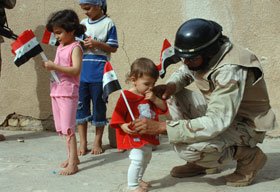
 From No End But Victory:
A Soldier back from Baghdad tried to explain to me the nature of our situation on the ground in Iraq. He, like so many, arrived in theater with blood in his eyes, his mission being to kill the enemy and secure the peace. This is what we train our Men and Women to do. They have been thoroughly trained, and are fully prepared to be ever vigilant; to protect and defend, and to do so with honor and integrity. They have done this in spite of the challenges they faced, and have won the war. This enemy is defeated in Iraq militarily. However, there is an inevitable transition in a theater of operations that requires our Soldiers to then “Win the Peace”, and this work continues in Iraq with many setbacks but many MORE successes.
He realized soon after arrival that the “blood in his eyes” mentality would not serve him well in winning the peace; that what he needed instead was solemnity, humility, respect and empathy and an open-mindedness that is at times hard to muster when you are being shot at and you are watching IED’s take out your brothers and sisters in the streets of Baghdad and surrounding areas. The balance of mind, the strength of conviction, the well-trained inclination to revert to a battlefield mentality, and the critical need to recognize each situation accordingly, react appropriately, AND know the difference, is the job description of our Soldiers in theater. I know almost no American citizen today that I would entrust my life to with these things as their responsibility, yet I completely trust our American Soldiers to do this routinely and as a matter of course.
As they do this work, our Soldiers live among the every-day average Iraqi citizen; the men, women, and children on the streets and in their homes, at school and work, in hospital, and in their house of worship. They have come to know each other, each with a tempered suspicion and a varying degree of mistrust and apprehension. Over time, these feelings have softened to an extent, and the Soldiers and the citizens have forged relationships; bonds of mutual reliance and shared need to rebuild lives and move ahead with the business of rebuilding a country.
The country we are rebuilding is unimaginable to anyone that has never been there. As described to me, many of these people are living in the sixth century; mud huts, no sanitation, no utilities to speak of outside the major city, or far enough removed from one of Hussein’s palaces. They live this way both mentally AND physically. They have been trained and have been led to believe that any non-Iraqi or non-Muslim “outsider” comes armed with a sword to behead them, and plunder and pillage their women and children and their ways of life. This is ingrained in them from birth, and reinforced throughout their relatively short lives; life expectancies hovering around 50 years. The parents, like parents in any society, are the teachers and trainers of their children and they merely pass along to the subsequent generations the wisdom and ideals they have grown to believe and presume to be correct. The story of the child bringing the note from the woman rings louder upon reflection;
[...]
A Soldier working to rebuild schools there tells of a day where a 2 ounce bottle of body lotion probably saved his life, and the lives of the soldiers attached to this mission. A fundamental element of a Soldier’s life in this Theater is to try and establish a relationship with the citizens; to show we are trying to help them, and guide them ever-so-slowly back on track and to pick themselves up and move forward with rebuilding a country that has never known even the simplest of things we take for granted every day. This Soldier gave one of his small bottles of body lotion to a local Iraqi woman, out of kindness, and in so doing introduced her to a small luxury she had never known before. She smiled appreciatively and went on her way. These bottles of body lotion are gold to a Soldier in Iraq and while relatively inexpensive, have saved many a chaffed hand or arm, and have even given a small taste of heaven out in that miserable desert with a thorough rubbing of the feet.
Several hours after this small act of kindness, an Iraqi child approached this Soldier, gave him a piece of paper with something written on it, and pointed to the Iraqi woman who had reappeared on the street. After the required 2 translators to verify the contents of the note, it was apparent she had offered information on the location of a weapons and ammunition cache. Upon investigation, it turns out her information was accurate and the weapons and ammunition was seized and ultimately destroyed. Countless lives were saved by that gesture of appreciation. These stories abound, and are increasing in number every day. From a small act of kindness comes an exchange of cooperation that saved lives and built lasting friendships while further strengthening a bond of trust and confidence.
[...]
this story could just easily ended in the death of that Soldier at the hands of a remotely detonated suicide vest strapped to that child, but it didn’t. It is highly likely that that Soldier WOULD have been felled by this child a few short years ago.
The future of this Iraqi child is uncertain, however, you can be sure he will carry with him the memory of that small contribution to breaking the circle of violence and hate and mistrust. He will remember that day, he will remember and recount to his peers the appreciation from the Soldier who’s life he helped protect, and the expression of gratitude from that Iraqi woman that he helped facilitate. So it is with countless more children in Iraq, and so will it be for our Soldiers when they return home.
Save the Children
 Many people have written about how they can help the children in Iraq. I began vetting, or scoping out NGO’s (Non Government Organizations) who have a firm foundation and strong programs. In addition, I have met with “up and coming” NGO’s who are developing strong programs but are still getting established, including training on organizational management and governance (more about these organizations in future posts).
I visited with Kurdistan Save the Children whose work expands Kurdistan and includes Baghdad. They are strong in education, youth centers and cultural centers, which they call Kaziwa which means ‘dawn’ in Kurdish. I visited one center in Sulaimaniya and was so pleased at the hard work four young men have
accomplished over the years.
They have developed a large youth center with many activities including sports, art, computer training, English classes, music rooms, computer rooms, internet café (the young people pay tiny fee which teaches them respect of equipment) exercise workout room (for both girls and boys, scheduled appropriately), a media and film department, cafeteria, and a huge center hall with a circle upper balcony, perfect for drum circles. He was very open to different activities including the drum circles that I suggested. Music and art in addition to other activities is strongly encouraged.
The manager of this center is a young man with his 3 associates and they have the drive and good hearts to help the children in the city. I was amazed at the dedication these people have given to develop this center for the youth. On the tour, he showed me one room after another, for different activities including dialogue groups and outside is a sports field and a beautiful garden.
His wish for the youth is an LCD and laptop for the classes and trainings, movie DVDs for the developing media department, additional books for the library, especially in English (books appropriate for 14-26 year olds, perhaps some American classics), musical instruments and… visitors, who are willing to spend time with the young people, whether through an activity, lecture or discussion.
Kurdistan Save the Children has other youth centers including Darbandikhan, Raniya, Koya, Kalar, Khanaqeen, Baziyan and Kirkuk and cultural centers in Halabja, Kirkuk, Qaladiza, and Raniya. In addition, they have Children’s homes in both Baghdad and Kirkuk which help Iraq’s growing number of street children, those affected most by the conflict and in need of the most help.
Read the rest here. If you can help, please do.
Europe has "Thrown a Blanket Of Surveillance" Over Terrorist Cells
Sometime last week the FBI and the Justice Department announced that they have launched "urgent new probes" against terrorist cells in New York City, and other parts of the United States.
My comments with regards to this announcement included the following:
We have to assume that the fact that such news has been released means things really are urgent. If they weren't the FBI and the Justice Dept. would have slowly, but surely, formed an airtight ring around these guys, in order to build a case, and catch them in the act.
I'm guessing the FBI and the Justice released this information because they are not sure whether they have been able to detect and monitor all the cells. Therefore, perhaps, they have concluded that it is better at this juncture to keep the terrorist cells worrying that they are being monitored.
Well, well, well, today it is coming out that "Senior security officials across Europe" are announcing that they have thrown a "blanket of surveillance" over terrorist cells.
Ok, yes, I'm sure they have. Let's look at a bit of the AP article:
MADRID, Spain - European intelligence networks have thrown a blanket of surveillance over a small but fiercely violent cast of Islamic militants, many homegrown with no direct links to al-Qaida, whose fingerprints they expect to find on the Continent's next big terrorist attack.
Senior security officials across Europe warned in interviews with The Associated Press that the relative ease and low cost of an attack, combined with the anger and isolation felt by Muslim populations, mean more bloodshed is almost inevitable.
The officials painted a picture of a diverse group of militants with competing agendas, vastly different social and educational backgrounds and a litany of gripes that makes it difficult to predict their next move. While they may be motivated by Osama bin Laden's call for worldwide jihad, they mostly operate independently of al-Qaida's leadership, the officials said.
"There is no profile; they come from everywhere," said Manfred Murck, deputy director of the German Office for the Protection of the Constitution, which tracks extremist activity in the northern city of Hamburg, home to three of the four Sept. 11 suicide pilots. "You can't concentrate on certain targets, you can't concentrate on certain persons ... Everything is possible, anything goes, and you just have to try and be as close as you can to the whole group."
The two deadliest recent attacks in Europe — the London bombings of last July 7 and the Madrid blasts of March 11, 2004 — dramatically illustrate the problem.
Two of the London bombers had shown up on the periphery of another terror investigation, but authorities did not deem them dangerous enough to merit closer surveillance.
Spanish authorities say they were also monitoring several of the bombers in the months before the Madrid attack — and actually stopped a car carrying the group's military planner in late February, unaware he was leading a caravan of other terrorists transporting explosives. They thought they were dealing with drug traffickers and let them go.
Armed partially with the lessons learned from those bombings, intelligence services throughout Europe are ramping up surveillance, even at the risk of provoking protests from civil liberties groups.
• In Spain, where 191 people died in the bombing of four trains, authorities have tripled the number of agents concentrating on terrorism and are watching some 250 suspected radicals, according to a senior intelligence chief at the heart of the country's counterterrorism operations, who spoke on condition of anonymity.
• In London, where four suicide attackers killed 52 bus and subway passengers, senior police officers say they are concerned about 40 to 60 people living in Britain who have received training at camps in Pakistan or Afghanistan, and who are believed intent on carrying out attacks. Another 400 are believed to be sympathizers.
• In Italy, authorities are watching 74 people on suspicion of financing terrorism, said Gen. Pasquale Debidda of the financial police. Germany's Murck said about 170 potentially violent radicals are under surveillance in Hamburg, and that they were believed to have another 2,000 sympathizers.
"We have recorded a significant increase in the number of threats" because of the cartoons, said Lars Findsen, the intelligence chief in Denmark.
The Internet is replacing militant mosques as the main meeting site for potential terrorists, said Sybrand van Hulst, the director of the Netherlands' CIA equivalent, the AIVD. It has also become their manual.
The Spanish intelligence chief said a search of the Madrid plotters' computers found they had often visited Global Islamic Media, the al-Qaida-linked Web site, before the attack and after, when they needed advice on making their getaway.
Authorities believe they learned how to rig their cell-phone bombs on the Web and even used the same brand of phones — Mitsubishi Trium T110s — as did the group behind the 2002 attacks in Bali.
The official said similarities between otherwise-unrelated attacks were evidence of the Web's power to spread terror information. The suicide attacks in London and those in Casablanca on May 16, 2003, were both carried out using the same peroxide-based explosives, which are easily made with common materials, but are extremely powerful.
The official said the terrorists don't know each other but chat a lot online, sharing their lessons and tactics. "They have recipes (for how to carry out an attack). It is the classic do-it-yourself handbook," he said.
As I said with regards to the FBI announcement, there is no good reason for European security officials to be releasing info on what they know about the enemy. Therefore, the release of such information is an attempt to intimidate the terrorists into not taking action.
This is a move of desparation, more than likely brought about by the fact that the intelligence organizations of both Europe and America know attacks are imminent, and feel as if they have lost control of the situation.
This does not bode well.
My comments with regards to this announcement included the following:
We have to assume that the fact that such news has been released means things really are urgent. If they weren't the FBI and the Justice Dept. would have slowly, but surely, formed an airtight ring around these guys, in order to build a case, and catch them in the act.
I'm guessing the FBI and the Justice released this information because they are not sure whether they have been able to detect and monitor all the cells. Therefore, perhaps, they have concluded that it is better at this juncture to keep the terrorist cells worrying that they are being monitored.
Well, well, well, today it is coming out that "Senior security officials across Europe" are announcing that they have thrown a "blanket of surveillance" over terrorist cells.
Ok, yes, I'm sure they have. Let's look at a bit of the AP article:
MADRID, Spain - European intelligence networks have thrown a blanket of surveillance over a small but fiercely violent cast of Islamic militants, many homegrown with no direct links to al-Qaida, whose fingerprints they expect to find on the Continent's next big terrorist attack.
Senior security officials across Europe warned in interviews with The Associated Press that the relative ease and low cost of an attack, combined with the anger and isolation felt by Muslim populations, mean more bloodshed is almost inevitable.
The officials painted a picture of a diverse group of militants with competing agendas, vastly different social and educational backgrounds and a litany of gripes that makes it difficult to predict their next move. While they may be motivated by Osama bin Laden's call for worldwide jihad, they mostly operate independently of al-Qaida's leadership, the officials said.
"There is no profile; they come from everywhere," said Manfred Murck, deputy director of the German Office for the Protection of the Constitution, which tracks extremist activity in the northern city of Hamburg, home to three of the four Sept. 11 suicide pilots. "You can't concentrate on certain targets, you can't concentrate on certain persons ... Everything is possible, anything goes, and you just have to try and be as close as you can to the whole group."
The two deadliest recent attacks in Europe — the London bombings of last July 7 and the Madrid blasts of March 11, 2004 — dramatically illustrate the problem.
Two of the London bombers had shown up on the periphery of another terror investigation, but authorities did not deem them dangerous enough to merit closer surveillance.
Spanish authorities say they were also monitoring several of the bombers in the months before the Madrid attack — and actually stopped a car carrying the group's military planner in late February, unaware he was leading a caravan of other terrorists transporting explosives. They thought they were dealing with drug traffickers and let them go.
Armed partially with the lessons learned from those bombings, intelligence services throughout Europe are ramping up surveillance, even at the risk of provoking protests from civil liberties groups.
• In Spain, where 191 people died in the bombing of four trains, authorities have tripled the number of agents concentrating on terrorism and are watching some 250 suspected radicals, according to a senior intelligence chief at the heart of the country's counterterrorism operations, who spoke on condition of anonymity.
• In London, where four suicide attackers killed 52 bus and subway passengers, senior police officers say they are concerned about 40 to 60 people living in Britain who have received training at camps in Pakistan or Afghanistan, and who are believed intent on carrying out attacks. Another 400 are believed to be sympathizers.
• In Italy, authorities are watching 74 people on suspicion of financing terrorism, said Gen. Pasquale Debidda of the financial police. Germany's Murck said about 170 potentially violent radicals are under surveillance in Hamburg, and that they were believed to have another 2,000 sympathizers.
"We have recorded a significant increase in the number of threats" because of the cartoons, said Lars Findsen, the intelligence chief in Denmark.
The Internet is replacing militant mosques as the main meeting site for potential terrorists, said Sybrand van Hulst, the director of the Netherlands' CIA equivalent, the AIVD. It has also become their manual.
The Spanish intelligence chief said a search of the Madrid plotters' computers found they had often visited Global Islamic Media, the al-Qaida-linked Web site, before the attack and after, when they needed advice on making their getaway.
Authorities believe they learned how to rig their cell-phone bombs on the Web and even used the same brand of phones — Mitsubishi Trium T110s — as did the group behind the 2002 attacks in Bali.
The official said similarities between otherwise-unrelated attacks were evidence of the Web's power to spread terror information. The suicide attacks in London and those in Casablanca on May 16, 2003, were both carried out using the same peroxide-based explosives, which are easily made with common materials, but are extremely powerful.
The official said the terrorists don't know each other but chat a lot online, sharing their lessons and tactics. "They have recipes (for how to carry out an attack). It is the classic do-it-yourself handbook," he said.
As I said with regards to the FBI announcement, there is no good reason for European security officials to be releasing info on what they know about the enemy. Therefore, the release of such information is an attempt to intimidate the terrorists into not taking action.
This is a move of desparation, more than likely brought about by the fact that the intelligence organizations of both Europe and America know attacks are imminent, and feel as if they have lost control of the situation.
This does not bode well.
Response to the US/Asia Minor Response

What follows is my original comment on the post regarding the US response, or lack thereof, regarding the Genocides perpetrated by the Young Turks in Asia Minor. It just turned out a little long, and I wanted to add some pictures, so I'm making it a post. Hope you guys don't mind too much:
Well, of course. Why would they want the full history to come to light? The US along with many European nations were tacitly complicit in the genocides in Asia Minor. Standard Oil among others was cozying up (throught the US Department of State, who had AMBASSADORS IN ASIA MINOR during the entire crisis!!) to Ataturk's fledgling government and everyone wanted a piece of Turkiye.
Never forget, the warships sat in Smyrna harbor in 1922 watching the burning of the city and the slaughter going on. The British seamen poured boiling water on swimmers trying to reach the ships for safety. The US revoked any rights of citizenship for any naturalized American citizens from Asia Minor who had returned to try to aid relatives.
Smyrna 1922: Victims Trapped Between the Flames and the Water
The list of crimes goes on, and if they admit to the genocides and the whole campaign of the Young Turks then everyone knows that they were there ignoring it all. People know anyway, it's rather public knowledge. It is the lack of focus on the subject which keeps this all under wraps.
The slogan, though in Klingon, er, I mean Turkish, was "Turkey for the Turks". They put everyone through this. And for the record, I know that this is always referred to as "The Armenian Genocide", and they were in fact one group of the victims. But so were the inland Pontic Greeks (pictured above on a death march) and the Assyrians who were slaughtered and put on similar death marches with little chance of escaping due to their geographic position (for a harrowing 1st hand account from a Pontic see Thea Halo's book Not Even My Name). My ancestors, the Ionian Greeks have been almost erased from history. They had a better chance for escape due to their living on the coast near the many islands and the rest of Greece. However, many of my relatives were murdered by Turks at this time. I'm merely the descendant of the ones who got away. I refer to this as the Genocides of the Young Turks or of Asia Minor personally, but it really strikes at the heart to think of the Armenians BARELY being remembered, while the other 4 groups targeted are not even MENTIONED. VDH in Between War and Peace mentioned the Ionians. He's a rare exception.
Understand my terseness here, these were my relatives. I know their names and the dates that some of them were bayonetted or shot to death. I know now who made it out and who didn't in my family and in others'. And as for the US resisting this move, they don't want to show their allegiance to a Turkey that was doing this or to lose what's left of an ally in the region. And having a Rockefeller still in the Senate can't be helping matters.
Sunday, May 28, 2006
The Trolls of Drollery
Guest Editorial by Edward Cline
On May 21st, the New York Times Book Review published the results of its survey, “What is the Best Work of American Fiction of the Last 25 Years?” Accompanying the dismal list of “winners” was an essay by A.O. Scott, “In Search of the Best.” With the typical absence of passion, criteria, and commitment that characterizes modern criticism and especially that of the New York Times, Scott, a film critic for the Times, neither applauds the survey results nor condemns them.
Scott describes the “Great American Novel” as a “crossbreed of romance and reportage, high philosophy and low gossip, wishful thinking and hard-nosed skepticism.” His nattering, gossipy article snickers at the subject of “best”, striving to assure its readers that the author could never be accused of valuing anything, not even the rubbish heap that passes for modern literature. It is just there, beyond judgment or comparison.
“…Late 20th century American Lit comprises a bustling menagerie, like Noah’s ark or the island of Dr. Moreau, where modernists and postmodernists consort with fabulists and realists, ghost stories commingle with domestic dramas, and historical pageantry mutates into metafiction. It is, gratifyingly if also bewilderingly, a messy and multitudinous affair.”
How can one judge? Should one judge? Scott asks but evades answering those questions, and abstains from judging the “best” works, twenty-two of them, just as he abstains from faulting or praising the over one hundred judges -- “prominent writers, critics, editors, and other literary sages” -- for their choices. Little is communicated in his essay but a contempt that percolates through an amused scorn for the whole subject. Comparing the “Great American Novel” with the yeti, Loch Ness monster and sasquatch, he notes, “The Times Book Review, ever wary of hoaxes but always eager to test the boundary between empirical science and folk superstition, has commissioned a survey of recent sightings.”
Focusing on the “winner” of the survey, Toni Morrison’s Beloved, Scott merely reports on the judges’ consensus:
“When the book first began to be assigned in college classrooms, during an earlier and in retrospect much tamer phase of the culture wars, its inclusion on syllabuses was taken, by partisans and opponents alike, as a radical gesture. (The conservative canard one heard in those days was that left-wing professors were casting aside Shakespeare in favor of Morrison.) But the political rhetoric of the time obscured the essential conservatism of the novel, which aimed not to displace or overthrow its beloved precursors, but to complete and to some extent correct them.”
“Enshrine mediocrity,” Ellsworth Toohey told Peter Keating in Ayn Rand’s The Fountainhead, “and the shrines are razed.” Reading Scott’s comments on the winning and neglected authors and their works, one is immediately certain that the idea of literary shrines is alien to him. He is a product of his age and education, a subjectivist/relativist who does not presume to venture beyond the perceptual and the visceral, or to question others’ appraisals. If his object is more demolition work, he is unaware that his literary and critical predecessors have already razed the shrines and that he is wandering through ruins overgrown by weeds, infested with vermin, and tenanted by vagrants. The great or notable literature of the past, to him, is a mirage. Who is he to hold himself or other writers up to a higher standard? Or to any standards? To Scott, the dishwater gray culture he sees before him is the norm.
“The American masterpieces of the mid-19th century…were compounded of precisely these elements [what he calls earlier realism, allegory, folk tale, Gothic and romance], and nowadays it seems almost impossible to write about that period without crossing into the realm of the supernatural, or at least the self-consciously mythic.”
Given the novels chosen by the Times judges as the “best” in the last twenty-five years, one might understand why Scott would consider the masterpieces of the 19th century an unattainable mirage. But Scott is not an innocent party; he helps to perpetuate the grayness. Not one of the survey novels deserves extended critical attention here; they all echo the common charge, as critics never tire of pointing out, that America is “mythic,” founded on violence, illusions, hypocrisy, racism, shallowness, and angst. It is a country based on fraud, and populated by trolls and gnomes.
Scott himself apparently does not aspire to anything greater than the stature of a troll. He writes effusively and with nagging drollery about modern literature in Harvard-taught patois, but devotes not one word to what “might and ought to be.” The concept is impossible to him. It is not a treasure trove of values that he seeks or regrets the loss of, but the chamber pots of modern American writers. What they have produced, is there. To Scott, nothing else is conceivable.
Against what literary or esthetic criteria does he measure modern literature? None. Such criteria do not exist, according to Scott. It is a “myth.” He might have redeemed himself had he attempted this kind of appraisal: “As modern France is no longer the France of Victor Hugo and Edmond Rostand, America is no longer the America of Hawthorne and Whitman.” But that kind of observation requires a perspicuity and intellectual honesty based on the knowledge that one is confined in a suffocatingly dreary, boring, bankrupt culture.
Scott, previously a book reviewer for Newsday, is also a frequent contributor to The New York Review of Books. He is representative of the modern profession of criticism, virtually indistinguishable in his philosophy and style from his colleagues who write for other major publications. He cannot take literature seriously enough to approach it with any passion or conviction. How could he or anyone stoke up a passion for the drearily undifferentiated trash the subjects of his essay? One holds a conviction about a truth. How could he have a conviction about anything when he claims there are no absolutes and no measures of value?
The measure he does employ is not esthetic or literary, but sociological. Scott calls it “cultural importance.” How does a particular work of fiction “reflect” its time, how well does it succeed in revealing the foibles, absurdities, dishonesty or hubris of society at this or that particular period of history? If one must portray individuals, they must be “types,” or symbols, or transparently neurotic or confused or helplessly miserable or oppressed, and readily identifiable by the random reader as a satirical mirror image of himself as victim or victimizer, or as a helpless, inconsequential cipher in a deterministic milieu.
Heroes? Achievements in the face of terrific odds? The larger-than-life? Happiness? Don’t make Scott laugh. And he will laugh, in chorus with the rest of the literary establishment.
“Every man to his taste,” goes the proverb, and it is claimed that “taste” cannot be accounted for. But, “taste,” or a hierarchy of specific literary and esthetic values, can be accounted for. One can reject the corrosives of naturalism, subjectivism, and nihilism, for which critics like Scott constantly shill in book reviews and essays, and instead measure or formulate literary and artistic values by an “ought.” It was done in the past; it can be done again.
Those who value literature, especially benevolent, heroic, Romantic, life-affirming literature -- literature, Ayn Rand once wrote, that serves as live-saving emotional or spiritual fuel to fight one’s own battles and that can propel one to accomplish one’s own goals -- in turn cannot take the likes of Scott or anything that passes for literature today seriously. Scott and his ilk cannot, on their premises, fight for or advocate anything of literary or artistic value. All they can do is gloat, and chant in their reviews and essays, “Such is life.”
All we can do is yawn, and work to stage a revolution in literature.
Crossposted at The Dougout
On May 21st, the New York Times Book Review published the results of its survey, “What is the Best Work of American Fiction of the Last 25 Years?” Accompanying the dismal list of “winners” was an essay by A.O. Scott, “In Search of the Best.” With the typical absence of passion, criteria, and commitment that characterizes modern criticism and especially that of the New York Times, Scott, a film critic for the Times, neither applauds the survey results nor condemns them.
Scott describes the “Great American Novel” as a “crossbreed of romance and reportage, high philosophy and low gossip, wishful thinking and hard-nosed skepticism.” His nattering, gossipy article snickers at the subject of “best”, striving to assure its readers that the author could never be accused of valuing anything, not even the rubbish heap that passes for modern literature. It is just there, beyond judgment or comparison.
“…Late 20th century American Lit comprises a bustling menagerie, like Noah’s ark or the island of Dr. Moreau, where modernists and postmodernists consort with fabulists and realists, ghost stories commingle with domestic dramas, and historical pageantry mutates into metafiction. It is, gratifyingly if also bewilderingly, a messy and multitudinous affair.”
How can one judge? Should one judge? Scott asks but evades answering those questions, and abstains from judging the “best” works, twenty-two of them, just as he abstains from faulting or praising the over one hundred judges -- “prominent writers, critics, editors, and other literary sages” -- for their choices. Little is communicated in his essay but a contempt that percolates through an amused scorn for the whole subject. Comparing the “Great American Novel” with the yeti, Loch Ness monster and sasquatch, he notes, “The Times Book Review, ever wary of hoaxes but always eager to test the boundary between empirical science and folk superstition, has commissioned a survey of recent sightings.”
Focusing on the “winner” of the survey, Toni Morrison’s Beloved, Scott merely reports on the judges’ consensus:
“When the book first began to be assigned in college classrooms, during an earlier and in retrospect much tamer phase of the culture wars, its inclusion on syllabuses was taken, by partisans and opponents alike, as a radical gesture. (The conservative canard one heard in those days was that left-wing professors were casting aside Shakespeare in favor of Morrison.) But the political rhetoric of the time obscured the essential conservatism of the novel, which aimed not to displace or overthrow its beloved precursors, but to complete and to some extent correct them.”
“Enshrine mediocrity,” Ellsworth Toohey told Peter Keating in Ayn Rand’s The Fountainhead, “and the shrines are razed.” Reading Scott’s comments on the winning and neglected authors and their works, one is immediately certain that the idea of literary shrines is alien to him. He is a product of his age and education, a subjectivist/relativist who does not presume to venture beyond the perceptual and the visceral, or to question others’ appraisals. If his object is more demolition work, he is unaware that his literary and critical predecessors have already razed the shrines and that he is wandering through ruins overgrown by weeds, infested with vermin, and tenanted by vagrants. The great or notable literature of the past, to him, is a mirage. Who is he to hold himself or other writers up to a higher standard? Or to any standards? To Scott, the dishwater gray culture he sees before him is the norm.
“The American masterpieces of the mid-19th century…were compounded of precisely these elements [what he calls earlier realism, allegory, folk tale, Gothic and romance], and nowadays it seems almost impossible to write about that period without crossing into the realm of the supernatural, or at least the self-consciously mythic.”
Given the novels chosen by the Times judges as the “best” in the last twenty-five years, one might understand why Scott would consider the masterpieces of the 19th century an unattainable mirage. But Scott is not an innocent party; he helps to perpetuate the grayness. Not one of the survey novels deserves extended critical attention here; they all echo the common charge, as critics never tire of pointing out, that America is “mythic,” founded on violence, illusions, hypocrisy, racism, shallowness, and angst. It is a country based on fraud, and populated by trolls and gnomes.
Scott himself apparently does not aspire to anything greater than the stature of a troll. He writes effusively and with nagging drollery about modern literature in Harvard-taught patois, but devotes not one word to what “might and ought to be.” The concept is impossible to him. It is not a treasure trove of values that he seeks or regrets the loss of, but the chamber pots of modern American writers. What they have produced, is there. To Scott, nothing else is conceivable.
Against what literary or esthetic criteria does he measure modern literature? None. Such criteria do not exist, according to Scott. It is a “myth.” He might have redeemed himself had he attempted this kind of appraisal: “As modern France is no longer the France of Victor Hugo and Edmond Rostand, America is no longer the America of Hawthorne and Whitman.” But that kind of observation requires a perspicuity and intellectual honesty based on the knowledge that one is confined in a suffocatingly dreary, boring, bankrupt culture.
Scott, previously a book reviewer for Newsday, is also a frequent contributor to The New York Review of Books. He is representative of the modern profession of criticism, virtually indistinguishable in his philosophy and style from his colleagues who write for other major publications. He cannot take literature seriously enough to approach it with any passion or conviction. How could he or anyone stoke up a passion for the drearily undifferentiated trash the subjects of his essay? One holds a conviction about a truth. How could he have a conviction about anything when he claims there are no absolutes and no measures of value?
The measure he does employ is not esthetic or literary, but sociological. Scott calls it “cultural importance.” How does a particular work of fiction “reflect” its time, how well does it succeed in revealing the foibles, absurdities, dishonesty or hubris of society at this or that particular period of history? If one must portray individuals, they must be “types,” or symbols, or transparently neurotic or confused or helplessly miserable or oppressed, and readily identifiable by the random reader as a satirical mirror image of himself as victim or victimizer, or as a helpless, inconsequential cipher in a deterministic milieu.
Heroes? Achievements in the face of terrific odds? The larger-than-life? Happiness? Don’t make Scott laugh. And he will laugh, in chorus with the rest of the literary establishment.
“Every man to his taste,” goes the proverb, and it is claimed that “taste” cannot be accounted for. But, “taste,” or a hierarchy of specific literary and esthetic values, can be accounted for. One can reject the corrosives of naturalism, subjectivism, and nihilism, for which critics like Scott constantly shill in book reviews and essays, and instead measure or formulate literary and artistic values by an “ought.” It was done in the past; it can be done again.
Those who value literature, especially benevolent, heroic, Romantic, life-affirming literature -- literature, Ayn Rand once wrote, that serves as live-saving emotional or spiritual fuel to fight one’s own battles and that can propel one to accomplish one’s own goals -- in turn cannot take the likes of Scott or anything that passes for literature today seriously. Scott and his ilk cannot, on their premises, fight for or advocate anything of literary or artistic value. All they can do is gloat, and chant in their reviews and essays, “Such is life.”
All we can do is yawn, and work to stage a revolution in literature.
Crossposted at The Dougout
CU Philosophy Chair on Ward Churchill
Diana Hsieh, at NoodleFood, has posted a letter written by the philosophy chair at CU, Bob Pasnau. The letter was published as an op/ed by the Boulder Daily Camera, registration required. The most interesting, and hopeful, part of the letter is Pasnau's statement that Churchill's frauds are the exception and not the rule at CU:
Diana is a graduate student in philosophy at CU.
Hat tip: Thrutch
Crossposted at The Dougout
Since the investigative report released earlier this month on the Churchill affair, little has been heard from CU faculty. This is understandable, since the whole affair is such a quagmire, but still the silence is unfortunate, since no one is so well placed to judge the matter. I hope these remarks will provide some helpful context.
A careful reading of the investigative report (available on CU's web site [here]) shows the committee to have discharged its duty with tremendous care for the many nuances of the case, scholarly and political. Ironically, however, the very care taken in the report, which runs to over 100 pages, may have kept the full seriousness of the charges from being fully appreciated. In short, the committee found two cases where Churchill extensively plagiarized the work of others. They found other cases where he first wrote articles under a false name, and then in a later work cited those earlier articles as providing independent confirmation for his own claims. They found a great many places where apparently detailed footnotes turned out on close inspection to offer no support whatsoever for the claims being made, and found that Churchill continued to stick with these false sources in later work even after being confronted in print with their inadequacy. Assessing the cumulative impact of these tactics, the committee describes "a pattern and consistent research stratagem to cloak extreme, unsupportable, propaganda-like claims of fact that support Professor Churchill's legal and political claims with the aura of authentic scholarly research by referencing apparently (but not actually) supportive independent third-party sources."
The fact that this disparate group of highly distinguished scholars could reach its verdict with complete unanimity -- save for the final, delicate question of what sanction to impose -- should give one a great deal of confidence in their verdict. No such confidence can be taken from Churchill's own statement (available on the Camera's web site [here]). A careful reading of the original report, next to his response, shows him to have misstated and ignored the committee's findings at every stage. Indeed, one might almost laugh at the way his slipshod responses reenact the very sorts of intellectual failings that the report originally highlighted.
One might laugh, that is, if the whole affair were not so depressing. Perhaps its most unfortunate aspect, beyond the immediate and very serious damage to CU, is the impression it seems to have left in some quarters that this is just the tip of the iceberg. Here my own experience is relevant. In the course of my duties evaluating the work of my colleagues, I have never encountered a single instance of fraud or misconduct, or even the bare allegation of such. Additionally, in all of the graduate seminars I have conducted, and dissertations I have read, I have never seen anything even remotely resembling this sort of conduct. Furthermore, over many years of evaluating thousands of job applicants, reviewing their qualifications with the greatest care, I have never seen or heard of even the shadow of this sort of behavior. Finally, in all my years of scholarly research, over the countless articles and books that I have read, I have never encountered anything of this kind.
Happily, it does not fall upon me to decide what sort of penalty is appropriate in this case. But were such misconduct discovered among my own faculty, or in my own field at large, I would be the first to seek that person's dismissal.
Professor Robert Pasnau
Chair, Department of Philosophy, CU/Boulder
Diana is a graduate student in philosophy at CU.
Hat tip: Thrutch
Crossposted at The Dougout
Subscribe to:
Posts (Atom)