Wednesday, May 30, 2012


From the Ace of Spades blog:
Apparently 'lean' AKA DXM is the street term for using dextromethorphan (the active ingredient in OTC Robotussin) mixed with sweet drinks to make it more palatable:
One of the recipes for "lean" calls for using Arizona Iced Tea Co.watermelon fruit juice cocktail as the beverage of choice, and Skittles candy. the items found on Trayvon Martin's body the night he was shot by George Zimmerman.
The Conservative Treehouse has a lengthy post about the recreational drug, it's effects and side effects, and alleged screen captures of Trayvon Martin's social media sites discussing his fondness for the concoction.
I remember hearing about 'Robo-ing' in college but based on my experiences with DM-based cough syrups while sick I figured that it would just make you super sleepy and dopey - which didn't sound all that appealing.
But apparently at higher dosages dextromethorphan begins to act more like PCP or ketamine. And there seems to be some pretty good evidence from Facebook posts that Trayvon was a regular user of 'lean' which could explain a lot about his behavior and actions that night.


Video: Gendercide at Planned Parenthood in Texas
Seriously, where is the feminist movement. If ever there was a cause tailor-made to fight, wouldn't the selective abortions of the unborn based on gender be it? Planned Parenthood has been caught... again. This time in a Texas clinic, advising a pregnant woman on how to use state funds to get an OB/GYN for late term ultrasounds to be used in the decision-making process of keeping or killing the baby based on its sex.
Another interesting aspect to this is that Planned Parenthood publicly denied this practice earlier this year.
Via DC:
In late April, Planned Parenthood suspected that it was the subject of such a sting operation. At the time, the group called Live Action’s tactic a hoax and condemned sex-selection abortions.There's nothing quite like being "pro-choice" and "pro-feminist" while supporting the "choice" of a woman to exterminate a member of your gender. Then, of course, lying about it doesn't help either.
“Planned Parenthood does not offer sex determination services; our ultrasound services are limited to medical purposes,” Planned Parenthood education vice president Leslie Kantor and Carolyn Westhoff, a senior medical adviser for Planned Parenthood, wrote. ”Gender bias is contrary to everything our organization works for daily in communities across the country. Planned Parenthood opposes racism and sexism in all forms, and we work to advance equity and human rights in the delivery of health care.”
“Planned Parenthood condemns sex selection motivated by gender bias, and urges leaders to challenge the underlying conditions that lead to these beliefs and practices, including addressing the social, legal, economic, and political conditions that promote gender bias and lead some to value one gender over the other,” the pair continued, asserting that stings such as Live Action’s are an attempt by “anti-choice” advocates to further “legislation that blocks access to basic reproductive health care, including birth control.”
And remember, once they lose their benefits, they are no longer counted as unemployed, but join the 5 million lost Americans.
And the government can report a drop in the unemployment rate.
Just in time for campaign season. . .
MSNBC/New York Times:
U.S. winds down longer unemployment benefits
Congress renewed extended aid, but phased in a reduction in the length
Hundreds of thousands of out-of-work Americans are receiving their final unemployment checks sooner than they expected, even though Congress renewed extended benefits until the end of the year.
And the government can report a drop in the unemployment rate.
Just in time for campaign season. . .
MSNBC/New York Times:
U.S. winds down longer unemployment benefits
Congress renewed extended aid, but phased in a reduction in the length
By SHAILA DEWAN
Hundreds of thousands of out-of-work Americans are receiving their final unemployment checks sooner than they expected, even though Congress renewed extended benefits until the end of the year.
The checks are stopping for the people who have the most difficulty finding work: the long-term unemployed. More than five million people have been out of work for longer than half a year. Federal benefit extensions, which supplemented state funds for payments up to 99 weeks, were intended to tide over the unemployed until the job market improved.
In February, when the program was set to expire, Congress renewed it, but also phased in a reduction of the number of weeks of extended aid and effectively made it more difficult for states to qualify for the maximum aid. Since then, the jobless in 23 states have lost up to five months’ worth of benefits.
Next month, an additional 70,000 people will lose benefits earlier than they presumed, bringing the number of people cut off prematurely this year to close to half a million, according to the National Employment Law Project. That estimate does not include people who simply exhausted the weeks of benefits they were entitled to.
Separate from the Congressional action, some states are making it harder to qualify for the first few months of benefits, which are covered by taxes on employers. Florida, where the jobless rate is 8.7 percent, has cut the number of weeks it will pay and changed its application procedures, with more than half of all applicants now being denied.
The federal extension of jobless benefits has been a contentious issue in Washington. Republicans worry that it prolongs joblessness and say it has not kept the unemployment rate down, while Democrats argue that those out of work have few alternatives and that the checks are one of the most effective forms of stimulus, since most of it is spent immediately.
After the most recent compromise reached in February, another renewal seems unlikely.
The expiration of benefits is one factor contributing to what many economists refer to as a “fiscal cliff,” or a drag on the economy at the end of this year when tax cuts and recession-related spending measures will all come to an end unless Congress acts. The Congressional Budget Office warned last week that the combination could contribute to another recession next year.
Candace Falkner, 50, got her last unemployment check in mid-May, when extended benefits were curtailed in eight states. Since then she has applied for food stamps and begun a commission-only, door-to-door sales job. Since losing her job two years ago, Ms. Falkner said, she has earned a master’s degree in psychology and applied for work at numerous social service agencies as well as places like Walmart, but no offers came.
Ms. Falkner, who lives on the outskirts of Chicago, said she was grateful for the checks she received. But when they ended, she said, “They should have had some program in place to funnel those people back into the job market. Not to just leave them out there cold, saying, ‘The job market has improved, but there’s still 60,000 people in the city who can’t find one.’ ”
Unemployment is lower than it was when the emergency unemployment extensions were ramped up in November 2009. Now, it is 8.1 percent, down from 9.9 percent then. But it is still far higher than pre-recession norms, and there are more than three job seekers for every opening.
Proponents of extended benefits say the cuts are premature. Chad Stone, the chief economist at the liberal Center on Budget and Policy Priorities, said Congress had never before put the brakes on extended benefits when the labor market was so weak. “It’s moving in the wrong direction, and it’s occurring at a time when unemployment is very high,” he said.
Conservative economists and political leaders have argued that unemployment benefits prolong joblessness and simply transfer wealth from one area of the economy to another without contributing to growth.
Kevin A. Hassett, director of economic policy studies at the conservative American Enterprise Institute, said, “I haven’t liked the 99-week solution from the beginning because it creates an environment where people are subsidized to become a structural unemployment problem.”
Still, he is troubled by the latest developments. “If you just reduce the weeks of unemployment for people already unemployed but don’t do anything else, it’s a bad deal,” he said, “because they’re already about the worst-off people in society.”
He points to alternatives like using unemployment money to encourage entrepreneurship or paying benefits in a lump sum, rather than over time, to encourage people to find work faster.
Most states offer 26 weeks of unemployment benefits, plus the federal extensions that kicked in after the financial crash.
The number of extra weeks available by state is determined by several factors, including the state’s unemployment rate and whether it is higher than three years earlier. So states like California have had benefits cut even though the unemployment rate there is still almost 11 percent.
“Benefits have ended not because economic conditions have improved, but because they have not significantly deteriorated in the past three years,” Hannah Shaw, a researcher at the Center on Budget and Policy Priorities, wrote in a blog post. In May, an estimated 95,000 people lost benefits in California.
After the recession, 99 weeks became a symbol of the plight of the jobless, with those who exhausted their benefits calling themselves “99 weekers” or “99ers.” But by the end of September, the extended benefits will end in the last three states providing 99 weeks of assistance — Nevada, New Jersey and Rhode Island.
Some states have tightened eligibility as well. Nationwide, most people apply for benefits by phone. Last August, Florida began requiring people to apply online and to complete a 45-minute test to assess their job skills, according to a complaint submitted to the federal labor secretary by the National Employment Law Project and Florida Legal Services.
The complaint said that applicants with limited Internet access or English skills, disabilities or difficulty reading had effectively been shut out, and that failure to complete the assessment was illegally being used to deny benefits. Denials have soared; now just over half of applicants are rejected. Nationally, 30 percent of applicants are rejected, according to the law project.
The changes have saved the state $2.7 million, according to James Miller, a spokesman for the Florida Department of Economic Opportunity. The state’s unemployment rate, he pointed out, has declined for 10 straight months. “The Department of Economic Opportunity provides accommodations to individuals with barriers to filing their claims,” he wrote in an e-mail. “D.E.O. welcomes any review and is certain that Florida’s statutory changes are in full compliance with federal law.”
The Labor Department is reviewing Florida’s unemployment program in response to multiple complaints, a spokesman said.
Tuesday, May 29, 2012
Weekly Standard:
Putin Rejects White House Talks
AFP reports: "Russian President Vladimir Putin earlier this month rejected an offer from United States (US) President Barack Obama for landmark bilateral talks at the White House, the Kremlin revealed on Tuesday."
Putin Rejects White House Talks
AFP reports: "Russian President Vladimir Putin earlier this month rejected an offer from United States (US) President Barack Obama for landmark bilateral talks at the White House, the Kremlin revealed on Tuesday."
Less than a week before Mr Putin's May 7 inauguration, he received a missive from Mr Obama touching upon bilateral and international issues and inviting him to discuss them in a bilateral summit on the sidelines of the May 18 to 19 G8 summit, Mr Putin's foreign policy aide Yury Ushakov said.
'Obama sent his letter on May 2,' Mr Ushakov told a briefing.
'He even proposed holding a separate meeting at the White House in Washington outside of the framework of the G8.'
Putin skipped the G8 talks at Camp David earlier this month, sending his trusted protege in his place.
Son of Stuxnet
RT:
Iran confirms ‘Flame’ cyber attack
High-ranking Iranian officials’ computers have been attacked by a newly detected data mining virus called “Flame,” an Iranian cyber defense group confirmed on Tuesday. The cyber attack is the most destructive since the Stuxnet virus.
Iran confirms ‘Flame’ cyber attack
High-ranking Iranian officials’ computers have been attacked by a newly detected data mining virus called “Flame,” an Iranian cyber defense group confirmed on Tuesday. The cyber attack is the most destructive since the Stuxnet virus.
Iran has deplored the “massive” data loss suffered since over the six months or more that Flame has been active. But the exact extent of damage has not been disclosed.
The newly spotted data mining virus may be the most harmful Iran has ever faced, even more dangerous than Stuxnet, warns Iran’s Computer Emergency Response Team Coordination Centre. Two years ago, Stuxnet destroyed several centrifuges used for Iran’s nuclear enrichment program.
“Flame” also appears to have been planted by a USB stick, which means a flash driver or a similar device had to have been inserted manually into at least one computer hooked up to the network.
“Those controlling the virus can direct it from a distance.' Flame' is no ordinary product. This was designed to monitor selected computers,” Kamran Napelian, an Iranian official, told The New York Times.
Still, Tehran says that the detection and clean-up tools were already finished in early May and can now be distributed among organizations at risk of infection.
Iran has suffered most due to the “Flame” attack, according to a report drawn up by Kaspersky Labs. The computers security company said 189 infections were reported in the Persian country, 98 in Israel and Palestine and 32 in Sudan. Other Middle East countries such as Syria, Lebanon, Saudi Arabia and Egypt were also under attack.
Despite Israel also falling under attack, Iran still thinks the malware was “made by Tel-Aviv.”
“Its encryption has a special pattern which you only see coming from Israel. Unfortunately, they are very powerful in the field of IT,” says another Iranian cyber defense official.
The number of massive cyber attacks on Iran now totals four, while no one has yet claimed responsibility for the Stuxnet assault in 2010. The attacks run parallel to a series of unexplained explosions and assassinations of Iranian nuclear scientists, constantly raising feeling in the nation that the country is increasingly being targeted by covert operations organized by the US and Israel.
Ahram:
Thousands protest against Egyptian election results; Shafiq HQ set on fire
Unidentified assailants attacked protestors in Tahrir Square at midnight, Monday, after thousands gathered to demonstrate against Egypt's election results, that will see Mubarak's last prime minister Ahmed Shafiq and the Muslim Brotherhood's Mohamed Mursi face each in a runoff vote on 16 and 17 June.
Two hours earlier, unknown individuals ransacked and set fire to the former regime member's presidential campaign headquarters in Dokki, Cairo. Security forces arrested those suspected of starting the blaze. Fire trucks brought the fire under control a short while later.
During Monday afternoon, hundreds had staged protests against the electoral outcome outside Egypt's Supreme Constitutional Court (SCC), and the headquarters of Egypt's Supreme Presidential Electoral Commission (SPEC) before joining Tahrir Square in the evening.
Similar protests took place across the country, including in Egypt's coastal city of Alexandria.
"We are sending a message to the Supreme Council of Armed Forces (SCAF) that we will never accept Ahmed Shafiq as our next president. He is the second Mubarak and was even in the Air Force like the ousted leader," says Aly, 24, a pharmacist who often works with the makeshift field hospitals during the clashes. "Personally I think the elections were rigged to put Mursi first, as it would have been a crisis if Shafiq was top – but, make no mistake, Shafiq is the military's man."
As the numbers grew to thousands, protesters– led by Khaled Ali, a former presidential contender and a left-wing labour lawyer – marched to Talaat Harb Square and around downtown Cairo before returning to Tahrir.
"Smash Shafiq on his head," the marchers chanted, whilst holding the former prime minister's presidential campaign posters upside down with his face crossed out.
Others chanted "Down with the dogs of the military regime" and called on bystanders on balconies overlooking Talaat Harb street to join them.
One protestor held a poster saying "If Shafiq wins, we are all dead" and others had the Ultras football fan flags of Zamalek White Knights team.
BEIRUT (AP) — Eyewitness accounts from the Syrian massacre emerged Tuesday, describing shadowy gunmen slaughtering whole families in their homes and targeting the most vulnerable in poor farming villages. Western nations expelled Syrian diplomats in a coordinated move against President Bashar Assad's regime over the killing of more than 100 people.
U.N. special envoy Kofi Annan met with Assad in Damascus to try to salvage what was left of a peace plan, which since being brokered six weeks ago has failed to stop any of the violence on the ground.
Survivors of the Houla massacre blamed pro-regime gunmen for at least some of the carnage as the killings reverberated inside Syria and beyond, further isolating Assad and embarrassing his few remaining allies.
"It's very hard for me to describe what I saw, the images were incredibly disturbing," a Houla resident who hid in his home during the massacre told The Associated Press on Tuesday. "Women, children without heads, their brains or stomachs spilling out."
He said the pro-regime gunmen, known as shabiha, targeted the most vulnerable in the farming villages that make up Houla, a poor area in Homs province. "They went after the women, children and elderly," he said, asking that his name not be used out of fear of reprisals.
Assad's government often deploys fearsome militias that provide muscle for the regime and carry out military-style attacks. They frequently work closely with soldiers and security forces, but the regime never acknowledges their existence, allowing it to deny responsibility for their actions.
U.N. peacekeeping chief Herve Ladsous said there are strong suspicions that pro-Assad fighters were responsible for some of the killings, adding that he has seen no reason to believe that "third elements" — or outside forces — were involved, although he did not rule it out.
The Syrian regime has denied any role in the massacre, blaming the killings on "armed terrorists" who attacked army positions in the area and slaughtered innocent civilians. It has provided no evidence to support its narrative, nor has it given a death toll.
Following his meeting with Assad, Annan called on the government and "all government-backed militias" to stop military operations and show maximum restraint. He also called on the armed opposition to stop all violence.
"We are at a tipping point," Annan told reporters in Damascus. "The Syrian people do not want the future to be one of bloodshed and division."
Cranking up the pressure on Assad, the Obama administration gave Syria's most senior envoy in Washington, the charge d'affaires at the Syrian Embassy, 72 hours to leave the United States. Britain, Canada, Australia, France, Germany, Italy, Spain and Bulgaria also expelled Syrian diplomats.
"We hold the Syrian government responsible for this slaughter of innocent lives," State Department spokeswoman Victoria Nuland said in Washington. "This massacre is the most unambiguous indictment to date of the Syrian government's flagrant violations of its U.N. Security Council obligations."
Monday, May 28, 2012
The U.N. Threat to Internet Freedom
From the Wall St. Journal:
On Feb. 27, a diplomatic process will begin in Geneva that could result in a new treaty giving the United Nations unprecedented powers over the Internet. Dozens of countries, including Russia and China, are pushing hard to reach this goal by year's end.
As Russian Prime Minister Vladimir Putin said last June, his goal and that of his allies is to establish "international control over the Internet" through the International Telecommunication Union (ITU), a treaty-based organization under U.N. auspices.
If successful, these new regulatory proposals would upend the Internet's flourishing regime, which has been in place since 1988. That year, delegates from 114 countries gathered in Australia to agree to a treaty that set the stage for dramatic liberalization of international telecommunications. This insulated the Internet from economic and technical regulation and quickly became the greatest deregulatory success story of all time.
Since the Net's inception, engineers, academics, user groups and others have convened in bottom-up nongovernmental organizations to keep it operating and thriving through what is known as a "multi-stakeholder" governance model.
This consensus-driven private-sector approach has been the key to the Net's phenomenal success. In 1995, shortly after it was privatized, only 16 million people used the Internet world-wide. By 2011, more than two billion were online—and that number is growing by as much as half a million every day.
This explosive growth is the direct result of governments generally keeping their hands off the Internet sphere. Net access, especially through mobile devices, is improving the human condition more quickly—and more fundamentally—than any other technology in history.
Nowhere is this more true than in the developing world, where unfettered Internet technologies are expanding economies and raising living standards. Enlarge Image Corbis Farmers who live far from markets are now able to find buyers for their crops through their Internet-connected mobile devices without assuming the risks and expenses of traveling with their goods.
Worried parents are able to go online to locate medicine for their sick children. And proponents of political freedom are better able to share information and organize support to break down the walls of tyranny. The Internet has also been a net job creator.
A recent McKinsey study found that for every job disrupted by Internet connectivity, 2.6 new jobs are created. It is no coincidence that these wonderful developments blossomed as the Internet migrated further away from government control.
Today, however, Russia, China and their allies within the 193 member states of the ITU want to renegotiate the 1988 treaty to expand its reach into previously unregulated areas.
Reading even a partial list of proposals that could be codified into international law next December at a conference in Dubai is chilling:
• Subject cyber security and data privacy to international control;
• Allow foreign phone companies to charge fees for "international" Internet traffic, perhaps even on a "per-click" basis for certain Web destinations, with the goal of generating revenue for state-owned phone companies and government treasuries;
• Impose unprecedented economic regulations such as mandates for rates, terms and conditions for currently unregulated traffic-swapping agreements known as "peering."
• Establish for the first time ITU dominion over important functions of multi-stakeholder Internet governance entities such as the Internet Corporation for Assigned Names and Numbers, the nonprofit entity that coordinates the .com and .org Web addresses of the world;
• Subsume under intergovernmental control many functions of the Internet Engineering Task Force, the Internet Society and other multi-stakeholder groups that establish the engineering and technical standards that allow the Internet to work;
• Regulate international mobile roaming rates and practices. Many countries in the developing world, including India and Brazil, are particularly intrigued by these ideas.
Even though Internet-based technologies are improving billions of lives everywhere, some governments feel excluded and want more control. And let's face it, strong-arm regimes are threatened by popular outcries for political freedom that are empowered by unfettered Internet connectivity.
They have formed impressive coalitions, and their efforts have progressed significantly.
ATTACK WATCH IS BACK!… Obama Website Now Supplies Easy-to-Use Snitch Forms For Truth Team Members
From Gateway:
ATTACK WATCH IS BACK!
The Obama Campaign now has an easy to use snitch form for its Truth Team members to fill out in case any non-Obama approved propaganda is found anywhere on TV, radio, in print, or on the Internet.
Here is a copy of the snitch form.
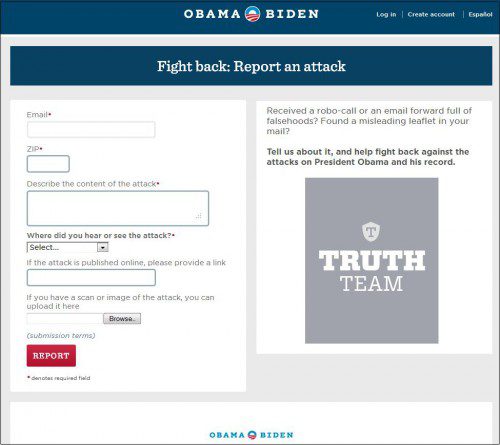
Click on the title to read the whole thing.
Subscribe to:
Posts (Atom)