Friday, November 08, 2013


OMFG: Nearly One Million Drop from Labor Force in October – Lowest Participation Rate Since Carter


The unemployment rate rose to 7.3% in October.
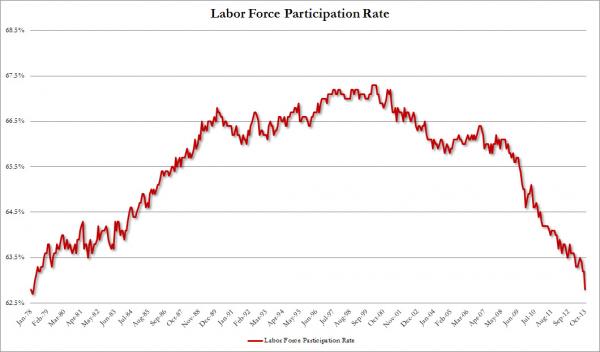
The US labor force participation rate, plunged from 63.2% to 62.8% in October. Zero Hedge added that the number of people not in the labor force exploded by nearly 1 million, or 932,000 to be exact, in just the month of October.
participation rate chart fail
It is the lowest participation rate since 1978 – during the Carter years.
CLICK ON THE TITLE TO GET THE WHOLE STORY.

Former MSNBC Host And #Occupy Supporter Dumped By Health Insurance Company


From Gateway Pundit:


Former MSNBC host and public supporter of the violent Occupy movement, Dylan Ratigan, took to Twitter last night to lament that he lost his health insurance thanks to Obamacare.
“Thnx Mr. President”
CLICK ON OVER TO GATEWAY TO GET THE WHOLE STORY.

MEANWHILE:


Of Hijabs, Burqas, And Rickets

Muslimatoon on Fleet Street in London

As mentioned back in 2007:
Hijab and burka-wearing Muslim women are putting their health at risk because they do not get enough sunlight, doctors have warned.

An alarming number of Muslim women who wear headdresses such as the hijab, which covers the head, neck and shoulders, and the burka, which covers everything except the eyes, are suffering from bone deficiencies due to lack of vitamin D.

Most of the body’s vitamin D, which helps calcium absorption and prevents the bone disorder rickets, is obtained through sunlight acting on the skin. Only a very small amount comes from food.

Women with darker skin are most at risk because it takes their bodies longer to produce the vitamin.

The NHS wants to encourage women from communities that embrace the hijab, such as those from Bangladesh, Pakistan and Somalia, to increase their vitamin D intake.

A Department for Health spokesman said: ‘For ethnic groups there is an increased risk of vitamin D deficiency.

Studies have shown low levels in Asian women in the United Kingdom – particularly among those who cover most of their skin for cultural reasons.’...
Now in 2013:
LONDON (AP) -- Rickets, the childhood disease that once caused an epidemic of bowed legs and curved spines during the Victorian era, is making a shocking comeback in 21st-century Britain....
No mention this time of hijabs and burkas. Mustn't ever insult Muslims, you know.
Chick Corea Trio
Tbilisi Jazz Festival 2012
Concert and Jam Session

Cancer Patient Has His Insurance Cancelled Because of Obamacare, New Plan So Expensive He’s Going To Pay Mandate Fine And Let “Nature Take Its Course”

Even worse, he voted for Obama.


This summary is not available. Please click here to view the post.

Don't Freak Out But the First 3D-Printed Metal Gun Totally Works


From the Atlantic of all places:
It reads like a plot of a dystopian novel: People develop a technology that allows them to manufacture—themselves, in the privacy of their own homes—working guns. Law enforcement is unable to regulate firearms. Chaos ensues.

When a design for The Liberator, the open-sourced and 3D-printed gun, was released last year, worriers could take some solace: The gun wasn't entirelycomposed of 3D-printed materials. The gun's firing pin—the thing, essentially, that put the fire in the firearm—was made of metal. And metal is extremely difficult to use as a material for 3D printing.
Until ... it's not. 
A company called Solid Concepts, which specializes in direct metal laser sintering, or DMLS, has created a gun, it claims, that is composed entirely of 3D-printed metal. The gun is not only fully metal-made; it is also capable of firing multiple rounds. (Liberator-style guns made of extruded plastic, on the other hand, are at this point able to fire one shot—ever.) The gun Solid Concepts is testing—and, indeed, using as a proof-of-concept—can fire 50 rounds. And be ready for more.

PEACE IN OUR TIME

'THIS IS A VERY, VERY BAD DEAL'


A very unusual statement from the Israel prime minister on the eve of a possible nuclear detail between the U.S. and Iran:


"I met Secretary Kerry right before he leaves to Geneva," said Netanyhau. "I reminded him that he said that no deal is better than a bad deal. That the deal that is being discussed in Geneva right now is a bad deal. It’s a very bad deal. Iran is not required to take apart even one centrifuge. But the international community is relieving sanctions on Iran for the first time after many years. Iran gets everything that it wanted at this stage and it pays nothing. And this is when Iran is under severe pressure. I urge Secretary Kerry not to rush to sign, to wait, to reconsider, to get a good deal. But this is a bad deal--a very, very bad deal. It’s the deal of a century for Iran; it’s a very dangerous and bad deal for peace and the international community."

AND THEN, THERE'S THIS:

Iranian state television broadcast simulated missile attack on Israel...


AND:

Obama secretly lifted Iran sanctions months ago...

In other words, Obama is a snake. Is that a surprise?

And remember what I told you yesterday.

UPDATE - A friend of mine sent an email commenting on this subject:

 
My view is that the left *wants* Iran to be nuclear-armed, as a 'counterweight' to Israel. They want Iran to be a stronger chess-piece. But they just can't admit that for domestic political-viability reasons so they have to pretend to care about all these sanctions, 'deals', and such. At some point Iran will be acknowledged to be a nuclear power and they'll be like 'well, we tried'.
That's just my baseline assumption about what's always going on with Iran. So, I assume that's what's happening here, in particular.
My answer to him:
The idea of thinking of Iran as a rational piece in an international nuclear chess game seems insane, on an apocalyptic level, to me.
I must not be crazy. You know why? Someone asked Obama a few years ago, "What keeps you up at night as President of the USA?"
His answer: "Pakistan."
We've already got one totally insane Islamic regime with nukes. Another only compounds the problem.


Data.healthcare.gov views of Market Premium Estimated Rates TODAY, 11-8: VIEWS DROP

BBC: Very Good, Hard-Hitting Interview With Spokescum from Muslim Council of Britain

"Give Me Your Fucking Sandwich" - Dinesh D’Souza Destroys ObamaCare

IF YOU LIKE YOUR STUPID PRESIDENT, YOU CAN KEEP YOUR STUPID PRESIDENT

Obama on NBC: I “Got Burned” By Obamacare Website That Didn’t Work

Or,

The Buck Stops In My Ass?


After discussing the content of the Affordable Care Act in his exclusive interview with President Obama, NBC News’ Chuck Todd moved on to the troubles that have plagued HealthCare.gov since the website launched on October 1st. Expressing serious frustration with the way the law rolled out, Obama said his team–and the American people–”got burned” by a website that doesn’t work.  
Having said all that, Obama added, “given that I’ve been burned already with a website–well, more importantly, the American people have been burned by–a website that has been dysfunctional, what we’ve also been doing is creating a whole other set of tracks.” He stressed how important it was for people to be able to sign up for insurance over the phone and in person. “What I’m confident about is that anybody who wants to buy health insurance through the marketplace, they are going to be able to buy it,” he said.

Lucy was kidnapped, gang raped - and then cruelly betrayed by the British justice system


  • In 2011, Lucy Walsh was abducted by three men after a night out
  • They raped her repeatedly, laughing when she cried out
  • Two were convicted and sentenced; police are looking for the third attacker
  • But the two successfully appealed and were given less prison time
  • And one of them was granted British citizenship while in jail
  • Fearful for her safety with an attacker still at large, Lucy has fled to Canada
That evening, in June 2011, she'd enjoyed a fun night with friends at a club in Preston, Lancashire. 
When she decided to call it a night, and walked alone the short distance to a taxi rank outside, no one was concerned. It was something Lucy, and thousands of young women, do without thinking every weekend. 
'The town was well-lit and lots of people were milling around, so I felt safe,' she says.Lucy's confidence was tragically misplaced, however, since two Kurdish men - Rezgar Nouri, 27, and Mohammed Ibrahim, 23 (a third - Araz Latif Najmaden, 21 - is still wanted in connection with the attack) had seen her in the nightclub and followed her out, and were caught by the club's CCTV cameras.
Rezgar Sharif Nouri
Mohammed Ibrahim
Attackers: Rezgar Nouri, 27, and Mohammed Ibrahim, 23, laughed as they repeatedly raped Lucy


Kerry To Israel: Why Do You Want To “Build In A Place That Will Eventually Be Palestine?”


Watch.

Rarely are we allowed to witness a man signed his ticket to hell with one sentence.

From the Times of Israel:
Turning to settlements and Israel’s presence in the West Bank, Kerry on Thursday denied rumors that there was an understanding that Israel would announce new settlement construction in exchange for releasing long-serving prisoners: 
”That is not the agreement. The agreement, specifically, was that there would be a release of the pre-Oslo prisoners — 104 [of them] — who’ve been in prison now for many many years, who would be released in exchange for the PA not proceeding to the UN during that period of time. 
“Now, the Palestinian leadership made it absolutely clear: they believe the settlements are illegal. They object to the settlements, and they are in no way condoning the settlements, but they knew that Israel would make some announcements. They knew it. But they don’t agree with it. And they don’t support it. They disagreed with it. In fact, they said, ‘We don’t agree. We do not think you should be doing settlements.’ “We, the United States, say the same thing,” Kerry continued. 
“We do not believe the settlements are legitimate. We think they’re illegitimate. And we believe that the entire peace process would in fact be easier if these settlements were not taking place. Now that’s our position… But we knew that there was not going to be a freeze. We didn’t negotiate a freeze.” 
Still, he said, Netanyahu had promised no settlement building that would change the “peace map” — presumably meaning no major expansion of settlements outside the major settlement blocs. 
Kerry argued that recent Israeli settlement plans show a lack of seriousness about the peace process. “Let me ask you something. How, if you say you’re working for peace and you want peace, and a Palestine that is a whole Palestine that belongs to the people who live there, how can you say we’re planning to build in a place that will eventually be Palestine?  
So it sends a message that perhaps you’re not really serious. If you announce planning, I believe it is disruptive to the process. But, the good side of it is, during the time we are negotiating, the planning will not translate into building and construction. And the prime minister has said he will not affect the peace map with the construction that takes place.

Defying Evil: Albert Camus and His Century


From Vladimir Tismaneau:

Tyrants conduct monologues above a million solitudes
–Albert Camus, The Rebel
I disagree with Bernard-Henri Lévy: the 20th century did not belong to Sartre. From the point of view of the Evil perpetrated, it was Lenin’s century. But if one takes honesty, truth, or Good as criteria, then it was Camus’s age. 
When we are assaulted by so much unsettling news, when we despair as we witness the rise of moral misery, when nihilism resurrects in front of our own eyes (but did it really lay dormant throughout all these years ravaged by ideological fantasies?), it is time to return to Albert Camus.
We often talk about “the treason of the intellectuals,” but we often forget that there were intellectuals who did not betray. Solzhenitsyn was no traitor. Neither was Havel. The Romanian political and religious thinker, Nicolae Steinhardt, did not abandon his principles even when tortured physically and psychologically. 
Camus was born a century ago on November 7, 1913. He died on January 4, 1960 in a tragic and absurd car accident. His work remains proof that one can live, think, and write with dignity without acquiescing in infamy. 
He diagnosed the malady of our times; he called it the plague. He knew that despite any illusions to the contrary, the totalitarian plague is always latent — ready to devastate both the soul and the society. 
I remember one sentence in The Rebel, which in fact is the cardinal principle warning us against utopian radicalisms: “None of the evils that totalitarianism claims to cure is worse than totalitarianism itself.” 
In times when seemingly there was no chance to challenge the advance of communist totalitarianism, when important Western intellectuals became mouthpieces for the so-called “campaign for peace,” Camus was among the very few who voiced the truth. 
He was one of those who unambiguously denounced the falsification of fundamental values such as Good and Evil. 
In those dark times, there were some intellectuals who refused to capitulate. They supported the struggle for political cultural freedom. 
--- One should list here intellectuals such as Raymond Aron, Arthur Koestler, Eugene Ionesco, George Orwell, Manès Sperber, Karl Popper, Karl Jaspers, Czeslaw Milosz, Ignazio Silone, Sidney Hook, Lionel and Diana Trilling, Isaiah Berlin, Dwight Macdonald, Nicola Chiaromonte, Ghita Ionescu, or the group from “Partisan Review” (Philip Rahv and William Phillips). ---
Impressed with the sincerity of Camus’s political and philosophical positions, Hannah Arendt described him as one of the few honorable people in 1950s Paris. In contrast with Jean-Paul Sartre, Francis Jeanson, Simone de Beauvoir or Maurice Merleau-Ponty, to give some examples, Camus did not have any reasons to be ashamed when, in February 1956, Nikita Khrushchev, Stalin’s heir, condemned “the cult of personality,” which in fact was the beginning of the condemnation of a system that was criminal from its very inception. 
For Camus, the totalitarian horrors, Dachau and Kolyma, were part of a global monstrosity provoked by the utopia of total social engineering, of the Crystal Palace meant to justify the Great Terror or the hysterical Kristallnacht. Nobody diagnosed as precisely as the author of The Plague the genealogy and the consequences of twentieth century demonic nihilism. 
In her book Camus: A Romance (Grove Press, 2009), Elizabeth Hawes fascinatingly reconstitutes, with great empathy, a spiritual, truly moral exemplary itinerary. Starting from searching the truth about Camus, discussing with his friends, relatives, and closed ones, the author seeks and finds the truth about herself. When many do not hesitate to talk about “Sartre’s century,” there are some of us who (maybe because of it) argue in favor of Camus’s moral pre-eminence. 
Political thinker Jeffrey Isaac has shown how Hannah Arendt and Albert Camus gave voice, in times that humiliated subjectivity, to the ethics of revolt. Along similar lines, one should remember historian Tony Judt’s volume about Camus, Raymond Aron and Léon Blum, The Burden of Responsibility (University of Chicago Press, 2007). 
I remember well what it meant for my generation, during communism, the publication of the novels The Stranger and The Plague, as well as of the essay The Myth of Sisyphus. We were fascinated with revolutionary infatuation, with violence and purification. Likewise, some of us were deeply moved by The Rebel, a book that circulated clandestinely, which we considered the perfect complement to Dostoyevsky’s The Demons. 
While Sartre and even Marleau-Ponty justified the Moscow show trials or communist terror in general as expressions of “the cunning of Reason,” Camus rejected those spurious rationalizations, considering them immoral and irresponsible. 
Sartre’s reply to The Rebel was a 300-page text in 1952, The Communists and Peace, a manifesto of ethical abjection and political abdication before Stalin’s disciples and/or agents. 
To Camus’s sorrow, Sartre also coordinated a negative campaign of reappraisals in the pages of the magazine where Camus had published two chapters of The Revel: in Temps Modernes. Sartre entrusted the besmirching of his former friend to a zealous and opportunistic young man eager to please his master, Francis Jeanson. 
There were very few who stood by Camus’s side. Among them there was Jean Grenier, his old philosophy professor, and poet René Char. Sartre himself intervened with a short, but extremely sarcastic text. He accused Camus of a supposedly supreme sin – that he wandered the Republic of Letters on a “portable pedestal” from which he lambasted Marxism for its responsibility in totalitarian crimes. 
Once asked what he would do if France was occupied by the Red Army, unfazed, the author of Being and Nothingness answered: “I will continue writing just as I did during the Nazi occupation.” Even later, Sartre continued to celebrate Marxism as “the definitive philosophy of our times.” 
During those years of shame and helplessness, Camus saved us. Sartre was a great thinker but profoundly cynical. Camus was a great thinker but committed to truth. 
He was a writer who rescued human dignity in a century devastated by concentration camps, gas chambers, mass graves, by Auschwitz, Katyn and the Gulag. 
For Camus, the philosophy of the absurd was one of resistance. Sisyphus never gives up; he continues his struggle, hoping against hope that someday he will prevail. Camus discovered in the very heart of revolt an element of thoughtlessness – the immoderation which he chose to explain rather than justify. 
The supreme virtue he commended, to the despair of Marxists and left-existentialists, was moderation. He denounced the Stalinist camps and he paid for his courage. He was exiled from the sectarian “fraternity” of Sartrian existentialism. He opposed torture irrespectively of who employed it. He contested capital punishment when many feared to do so. He was equally a great writer and a great moralist. 
Slandered and belittled by the metaphysical snobs of an honorless epoch, Camus remains one of the solid references of antitotalitarian consciousness. Albert Camus was one of exiled Romanian intellectuals Monica Lovinescu’s and Virgil Ierunca’s favorite writers. This was so exactly because he combined, in a tragic synthesis, ethics with aesthetics. Camus’s death, a thinker whom they loved and identified with on grounds of his unwavering fidelity to the truth, was a terrible blow. 
André Marlaux was right: “Death turns life into destiny.” That year, 1960, news from Romania were even worse as any hope of reuniting with Monica’s mother (who was imprisoned for refusing to collaborate with the communist regime) vanished and totalitarianism reigned unchallenged in Bucharest. To use the title of a novel by Victor Serge, “it was midnight in the century.” 
Albert Camus, Nadezhda Mandelstam, Aleksandr Solzhenitsyn, Yelena Bonner, Vaclav Havel, Leszek Kolakowski, Andrei Sakharov, Yuri Glazov, Monica Lovinescu and Virgil Ierunca were honest intellectuals despite the hardships of a humiliating epoch of totalitarianisms. 
Their legacy is that of modest virtues that prevailed over countless sins. In Monica Lovinescu’s words: 
“Honesty, the duty to question certainties, the endorsement of relative but concrete values, the unrest of never-ending doubt. No salvos, no trumpets, no headlines. Only the necessity, by way of such seemingly tentative methods, to defend human beings from ideological fantasies that kill more inexorably than violence itself.” 
When so many indulged in lies, hypocrisy, double-think, and double-talk, these intellectuals cultivated truth, dignity, and honor.